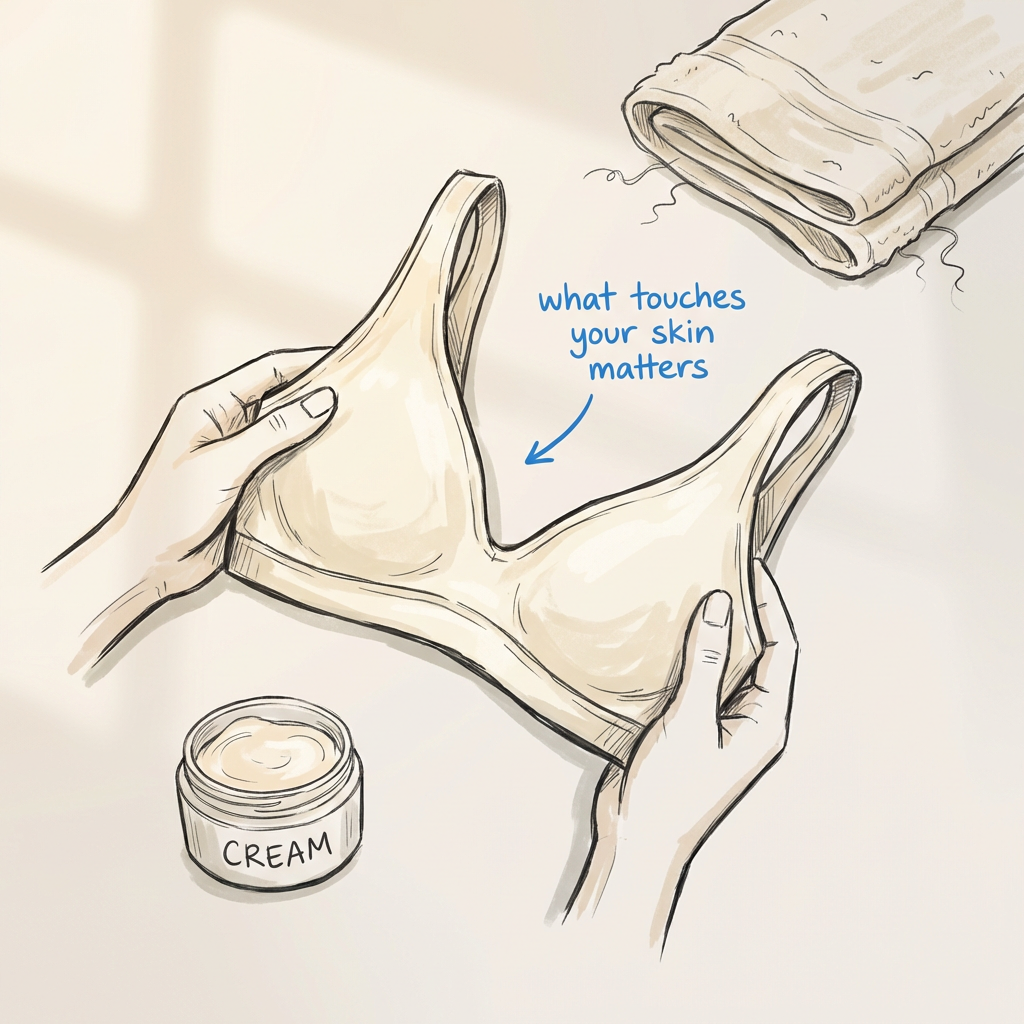
Your radiation oncology team gave you a skin care sheet. It covers creams, cleansers, and sun protection. It probably says “wear a soft bra.” What it likely does not explain is what “soft” actually means when your chest is tender, swollen, and peeling.
That is where this guide picks up. Skin care during radiation treatment is about what you put on your skin and what you put against it for the other sixteen hours of the day. The moisturizer matters. But so does the bra pressing against irradiated tissue between sessions. Both deserve the same attention.
How Radiation Changes Your Skin Week by Week
Radiation therapy for breast cancer typically runs five days a week for three to six weeks. The beam targets cancer cells, but it also affects the skin in the treatment field. Knowing the timeline helps you plan your skin care routine and your wardrobe together.
Weeks 1-2: Skin may look normal or slightly pink, like a mild sunburn. Most women feel fine in their usual bras. This is the window to prepare, not wait.
Weeks 3-4: Redness deepens. Skin becomes dry, itchy, and tender. Seams that never bothered you before feel like sandpaper. Underwires press on swollen tissue. Synthetic fabrics trap heat against already-inflamed skin.
Weeks 5-6 and beyond: Some women develop moist desquamation (areas where the top layer of skin breaks down and weeps). The skin in breast folds and along bra lines is especially vulnerable because of friction and moisture. At this stage, the wrong bra can delay healing.
After treatment ends: Skin continues to react for one to three weeks after your final session. Full healing can take several months. The treated area may remain more sensitive, thinner, and more prone to irritation well after treatment is complete. Sun protection becomes especially important during this period and for at least a year afterward.
Key takeaway: Radiation skin damage is cumulative. The bra that feels fine in week one may be intolerable by week three. Plan garment changes early.
Skin Care Basics Your Treatment Team Will Cover
Your radiation oncology team will give you specific instructions. Always follow their guidance over anything you read here. These are the general principles most treatment centers recommend.
Cleansing: Wash the treatment area gently with lukewarm water and a mild, fragrance-free soap. Pat dry with a soft towel. Never rub. Some teams prefer water only in the treatment field.
Moisturizing: Apply a gentle, unscented moisturizer after each wash and as needed throughout the day. Common recommendations include Aquaphor, Eucerin, calendula cream, and pure aloe vera gel (without added fragrances or alcohol). Most radiation centers ask you to apply nothing to the skin for two to four hours before your treatment session, since a moisturizer barrier can affect dose delivery. Ask your team about their specific timing rules.
What to avoid: Deodorants and perfumed products on the treatment area. Adhesive bandages or tape on irradiated skin. Hot or cold compresses directly on the treatment field. Shaving the treatment area with a blade razor.
When to call your team: Contact your radiation oncology nurse if you notice blistering, open sores, significant peeling, signs of infection (increased warmth, pus, or fever), or pain that interferes with sleep.
If you are also dealing with dry skin from breast surgery, layering a gentle moisturizing routine now will serve you through both recoveries.
Key takeaway: Gentle cleansing, consistent moisturizing, and avoiding irritants form the foundation. A cream you apply twice a day works best alongside a bra that is not creating friction the rest of the time.
What to Look for in a Radiation-Friendly Bra
Your oncology team’s advice to “wear a soft bra” is a good starting point. Here is how to put it into practice.
Fabric: Cotton and Breathable Blends
Irradiated skin needs air circulation. Synthetic fabrics trap heat and moisture, creating conditions that worsen radiation dermatitis (the medical term for radiation-related skin irritation). Look for bras made primarily from cotton or cotton-modal blends. Some women find bamboo-viscose blends work well for their softness and moisture-wicking properties. If the interior of the bra cup feels like activewear material, it is not the right choice during treatment.
Seams: Flat or None
On healthy skin, you do not notice bra seams. On irradiated skin, every seam is a friction point. Look for bras with flat seams or seamless cup construction. Pay particular attention to the band area under the breast and the side seam near the armpit. Breast fold radiation dermatitis, where the lower breast meets the ribcage, is one of the most common and painful reactions. A raised seam in that spot can turn a manageable reaction into a daily ordeal.
Closure: Front-Close
Many women in radiation treatment also have limited arm mobility, especially after axillary lymph node dissection or sentinel node biopsy. Reaching behind your back to hook a standard bra can be painful or impossible. Front-closure bras solve this. You step in or pull on and close at the center front. Even if your arm mobility is fine, front closures reduce the handling and friction against sensitive skin.
Wire-Free: Non-Negotiable
Underwires press firmly into the inframammary fold (the crease at the base of the breast). During radiation, this fold is often the first area to develop serious skin breakdown. An underwire on irradiated skin is a direct path to pain, blistering, and delayed healing. Wire-free construction is a clinical necessity, not a preference.
Key takeaway: Breathable fabric, flat or no seams, front closure, and wire-free construction. If a bra fails on any one of these, it is working against your skin care routine.
Day and Night: Different Garment Needs
Daytime: You need light support without compression. A soft, wire-free bra with wide, adjustable straps distributes weight without digging in. If you reach a point where any cup contact is too much, a soft cotton camisole with a built-in shelf bra can provide modest support without direct pressure on the treatment area.
Nighttime: When you lie on your side without a bra, breast tissue folds against chest skin, trapping heat and moisture right where radiation dermatitis concentrates. A lightweight sleep bra or cotton crop top keeps a thin layer of breathable fabric between skin surfaces. It does not need to provide real support, just separation. Look for pull-on styles with no hooks, no clasps, and no seams along the lower band. Women also dealing with scar tissue from surgery may find that a gentle sleep bra reduces overnight irritation on both fronts.
Key takeaway: A lightweight sleep bra that separates skin-on-skin contact can be just as important for healing as your daytime bra.
Expect Your Fit to Change
Your bra size is not static during radiation. Skin swelling, tissue tenderness, and medication-related weight changes can all alter how a bra fits from week to week. The band may feel tighter as chest wall skin swells. Cup volume may increase slightly on the treated side due to edema. Straps may irritate where they never did before.
Many women benefit from having two or three radiation-friendly bras in slight size variations, or choosing styles with significant stretch and adjustability. A professional fitting from someone who understands post-surgical and radiation bodies is worth the time. A certified fitter who works with treatment patients knows how to assess fit on swollen, tender tissue without causing pain and can recommend styles that accommodate the changes ahead.
If your skin care routine is already adapting with the change of seasons, your bra rotation deserves the same flexibility.
Key takeaway: The bra that works in week one may not work in week four. A certified fitter can save you weeks of trial and error.
Frequently Asked Questions
Can I wear a bra during radiation treatment?
Yes. Choose one that is wire-free, soft-fabric, flat-seamed, and ideally front-closing. Your team may ask you to remove it during sessions, but you can wear an appropriate bra the rest of the day. If any contact is painful, a loose cotton camisole works as an alternative.
What should I put on my skin during radiation for breast cancer?
Most teams recommend a gentle, unscented moisturizer such as Aquaphor, Eucerin, calendula cream, or pure aloe vera gel. Apply after washing and as needed, but not within two to four hours before treatment. Always follow your team’s specific instructions.
How long does radiation skin damage last?
Reactions typically peak one to two weeks after your final session and then gradually improve. Mild redness may resolve within weeks. More significant reactions like moist desquamation can take six to eight weeks to fully heal. Some women notice lasting sensitivity or dryness for months afterward.
What bra is best after lumpectomy and radiation?
A wire-free, front-closure bra made from cotton or a soft cotton blend with flat seams. A professional fitting is especially valuable after lumpectomy because breast shape and volume may change, and standard sizing may not account for asymmetry.
Your Skin Deserves Comfort on Both Sides
Radiation skin care works best when the creams and cleansers on your bathroom counter are matched by the right garments in your dresser drawer. One without the other leaves a gap.
Front Room Underfashions carries soft, wire-free, cotton-blend bras with flat seams and front closures. Their ABC-accredited certified fitters have years of experience fitting women during and after breast cancer treatment, and they understand how radiation changes your body and your fit needs.Schedule a free fitting consultation whenever you are ready. We will take care of you.