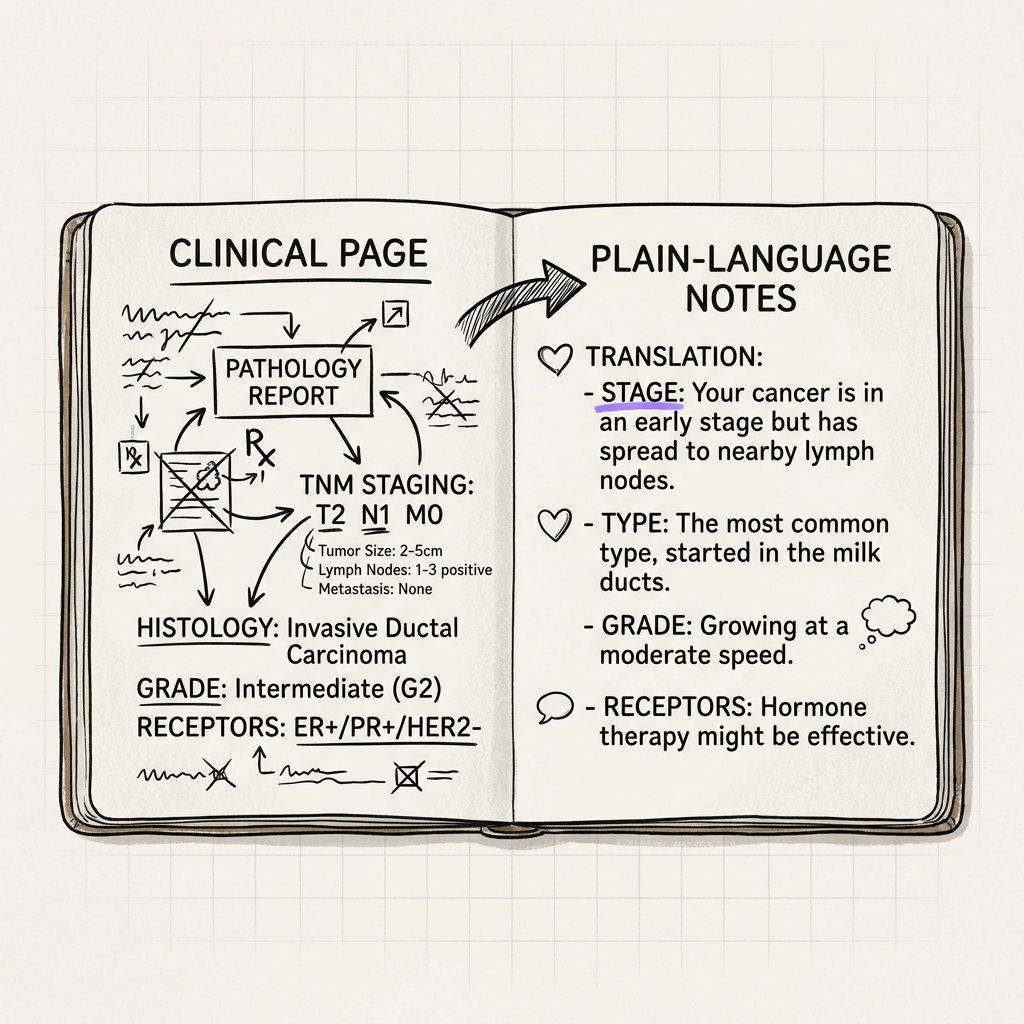
Your doctor said a number. Maybe a letter or two. And now you’re sitting with your phone, trying to figure out what Stage II or “ER-positive” actually means for your life.
That is a completely reasonable place to be right now. The medical language around a breast cancer diagnosis can feel like a wall between you and understanding what is happening to your own body. This guide is here to bring that wall down. We will walk through the stages, the types, and the terms your care team uses so that when you sit down with your oncologist, you already have a foundation.
One thing to know before we start: Front Room Underfashions is not a medical provider. This is general educational information, not medical advice. Your oncologist knows your specific case, and your treatment plan will be built around your unique diagnosis. What we can do is help translate the language so it makes more sense when you hear it.
What Staging Actually Tells You
Staging is your care team’s way of describing how far the cancer has developed. They look at three things: the size of the tumor (called T), whether cancer cells have reached nearby lymph nodes (called N), and whether the cancer has spread to other parts of the body (called M). Together, these form the TNM system (tumor, nodes, metastasis) that places your diagnosis into a stage from 0 through IV.
The stage helps your oncologist choose the treatment path that fits your situation. It is not a prediction of your future. Two women with the same stage can have very different experiences depending on the type of cancer, how their body responds to treatment, and other factors their care team will evaluate.
Key takeaway: Staging describes where things stand right now. It guides treatment decisions, but it does not define your outcome.
The Stages, in Plain Language
Stage 0 means abnormal cells were found, but they have not spread beyond where they started. The most common form is DCIS (ductal carcinoma in situ), which means abnormal cells are inside the milk ducts but have not pushed through into surrounding tissue. Many women with Stage 0 are treated with minor surgery and monitoring. It is still cancer, and it still deserves attention.
Stage I means the tumor is small, usually no larger than two centimeters (about the size of a peanut), and the cancer is contained in the breast. Some Stage I diagnoses include tiny amounts of cancer in a nearby lymph node. Treatment often involves surgery, and your oncologist may recommend radiation or medication depending on the specifics.
Stage II means either the tumor is larger or a small number of lymph nodes are involved, or both. This is a stage where treatment plans start to vary more widely. Some women have surgery first; others begin with chemotherapy to shrink the tumor before surgery. Your care team will walk you through the options that make sense for your specific case.
Stage III means the cancer is larger or has spread to several lymph nodes near the breast or chest wall, but it has not traveled to distant organs. Treatment usually involves a combination of approaches: chemotherapy, surgery, and radiation. This stage often means a longer treatment timeline, and that is where planning for recovery ahead of time can help you feel more prepared.
Stage IV means the cancer has spread beyond the breast and nearby lymph nodes to other parts of the body, such as bones, lungs, liver, or brain. This is also called metastatic breast cancer. Stage IV is treatable. Many women live with metastatic breast cancer for years with ongoing treatment that manages the disease and maintains quality of life. Your oncologist will talk with you about the treatment approach that fits your goals.
Key takeaway: Each stage describes how far the cancer has developed. Lower stages are more contained; higher stages involve more spread. All stages have treatment paths.
Types of Breast Cancer and Why They Matter
Not all breast cancers behave the same way. Beyond staging, your pathology report will identify the type of cancer, which tells your care team how it grows and what treatments are most likely to work.
Invasive ductal carcinoma (IDC) is the most common type, accounting for about 70-80% of breast cancers. It starts in the milk ducts and has spread into surrounding breast tissue.
Invasive lobular carcinoma (ILC) starts in the lobules (the glands that produce milk) and accounts for about 10-15% of cases. ILC can be harder to detect on mammograms because it tends to grow in a different pattern than ductal cancers.
Inflammatory breast cancer is rare and aggressive. It often does not form a lump. Instead, the breast may look red, swollen, or feel warm. Because it looks different from what most people picture when they think of breast cancer, knowing how to examine your own breasts matters.
Your pathology report may also mention the tumor grade, which describes how abnormal the cells look under a microscope. Grade 1 cells look most like normal cells and tend to grow slowly. Grade 3 cells look very different from normal cells and tend to grow faster.
Key takeaway: The type and grade of your cancer tell your care team how it behaves, which shapes the treatment plan alongside your stage.
What Receptor Status Means
Your pathology report will include receptor status results. These tell your oncologist whether your cancer cells have specific proteins on their surface that help the cancer grow.
Hormone receptor positive (HR+) means the cancer cells have receptors for estrogen (ER-positive), progesterone (PR-positive), or both. About 70-80% of breast cancers are hormone receptor positive. This is useful information because it means hormone therapy medications can block those receptors and slow or stop the cancer’s growth.
HER2-positive means the cancer cells have too much of a protein called HER2 (human epidermal growth factor receptor 2), which fuels cell growth. Targeted therapies exist specifically for HER2-positive cancers.
Triple-negative means the cancer is ER-negative, PR-negative, and HER2-negative. It does not respond to hormone therapy or HER2-targeted treatments. Chemotherapy is the primary approach, and newer immunotherapy options are expanding what is available.
These details may feel like a lot to absorb right now. You do not need to memorize them. What matters is that your oncologist uses this information to choose the treatments most likely to work for your specific cancer.
Key takeaway: Receptor status tells your care team which treatments can target your cancer most effectively. It is one of the most important pieces of your pathology report.
What Happens Next After a Diagnosis
Once your staging, type, and receptor status are known, your oncologist will outline a treatment plan. This might include surgery, chemotherapy, radiation, hormone therapy, targeted therapy, or a combination.
Some practical things to know: if surgery is part of your plan, ask your surgeon about what to expect during recovery and what kind of support garments you may need afterward. Many women do not think about this before surgery and then find themselves unprepared. Understanding what a post-surgical compression bra does and how long you will wear one can take one more question off your plate.
If radiation is part of your treatment, know that it can change how your skin feels and how certain fabrics sit against your body. Skin care during radiation is something worth reading about before you start.
Write down your questions before each appointment. Bring someone with you who can take notes. And give yourself permission to take this one step at a time.
Key takeaway: Treatment plans are built around your specific diagnosis. Asking questions and preparing for practical changes makes the process easier to manage.
You Do Not Have to Figure This Out Alone
A breast cancer diagnosis brings a flood of information, and it is normal to feel like you are trying to drink from a fire hose. The stages, types, and receptor terms will start to make more sense as you talk with your care team and learn more about your specific case.
Front Room Underfashions has been sitting with women at this exact moment for over 40 years. Lenore Shebuski founded this boutique in 1980 after her own diagnosis because she believed women deserved better than being fit for a prosthesis next to a shelf of bedpans. Crystal and Heather carry that same commitment today, meeting women inside the Herbert Herman Cancer Center and Karmanos/McLaren so they do not have to make a separate trip during an already overwhelming time.
Whenever you are ready, we are here. Whether you need a fitting, have questions about what comes next for your body, or just want to talk to someone who has helped thousands of women walk through this chapter, come in. No appointment necessary. No pressure. Just support.