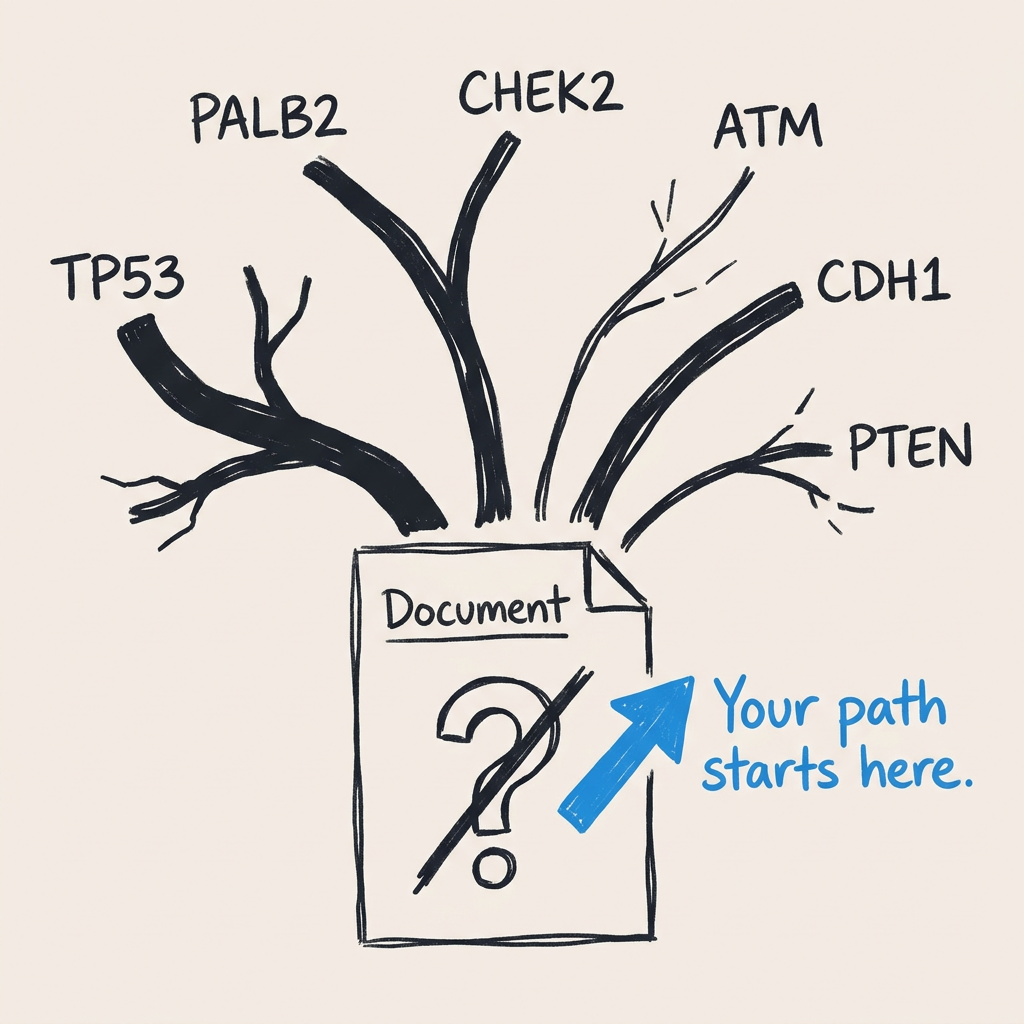
Your genetic test results came back. You don’t have BRCA1 or BRCA2. But something did show up. Maybe it says PALB2. Maybe CHEK2. Maybe there’s a phrase you’ve never seen before: “variant of uncertain significance.” And now you’re staring at a piece of paper that was supposed to give you answers, but instead it’s given you a whole new set of questions.
You are not alone in this. Multi-gene panel testing has become standard practice, and more women are receiving results for genes that didn’t get mentioned in the same breath as BRCA even five years ago. The science has caught up. The public conversation hasn’t. That gap between what the lab report says and what it actually means for your life is exactly where most women get stuck.
This is a guide through that gap.
The Genes That Don’t Make the Headlines
BRCA1 and BRCA2 get the attention because they were discovered first and because they carry the highest risk. But they account for only about 25% of hereditary breast cancers. The rest are linked to a growing list of other genes, each with its own risk profile, its own screening recommendations, and its own set of decisions.
Here are the ones that matter most.
PALB2 stands for “partner and localizer of BRCA2.” It works directly with BRCA2 to repair damaged DNA, and when it’s mutated, those repairs don’t happen the way they should. Lifetime breast cancer risk for women with a PALB2 pathogenic variant ranges from roughly 40% to 60%, depending on family history. That puts PALB2 in the high-risk category, and NCCN guidelines now recommend the same enhanced screening and risk-reduction conversations that BRCA carriers receive. If BRCA has a close cousin, PALB2 is it.
CHEK2 is one of the most commonly identified mutations in breast cancer genetic panels. It acts as a checkpoint in cell division, catching errors before they become permanent. A CHEK2 mutation raises lifetime breast cancer risk to roughly 20% to 30%. That places it in the moderate-risk range, which means the screening and management conversation looks different than it does for BRCA or PALB2. Most women with CHEK2 are recommended annual mammograms and breast MRI starting at age 40, but prophylactic mastectomy is generally not the first-line recommendation. That distinction matters, and it’s one that gets lost in a Google search.
ATM (ataxia-telangiectasia mutated) helps repair double-strand DNA breaks. A pathogenic ATM variant carries a lifetime breast cancer risk of roughly 15% to 40%, with the range depending heavily on family history and the specific mutation. Like CHEK2, it falls into the moderate-to-high risk category and comes with its own screening guidelines. NCCN recommends enhanced screening with annual mammograms and breast MRI beginning at age 40 for most ATM carriers.
TP53 mutations cause Li-Fraumeni syndrome, which is rare but serious. Lifetime breast cancer risk can exceed 50%, and the cancer often develops at younger ages. Women with TP53 mutations typically begin annual breast MRI screening at age 20. Because radiation exposure is itself a concern with Li-Fraumeni syndrome, the screening approach is different from other high-risk genes, and conversations about risk-reducing mastectomy happen early.
CDH1 and PTEN are less common but also carry significant risk. CDH1 mutations are associated with hereditary diffuse gastric cancer and lobular breast cancer, with lifetime breast cancer risk in the 40% to 50% range. PTEN mutations (Cowden syndrome) carry a lifetime breast cancer risk of up to 85% and require a comprehensive screening approach for multiple cancer types.
Key takeaway: BRCA1 and BRCA2 are not the full picture. Genes like PALB2, CHEK2, ATM, TP53, CDH1, and PTEN each carry their own risk levels and their own recommended screening timelines. Knowing which gene you carry changes what happens next.
When the Result Says “Variant of Uncertain Significance”
Some women get their results back and the report doesn’t say “pathogenic” or “benign.” It says VUS, short for variant of uncertain significance. In plain language, that means the lab found a change in the gene, but there isn’t enough evidence yet to determine whether that change actually increases cancer risk. It’s not a positive result. It’s not a negative result. It’s an “we don’t know yet.”
This is more common than most people expect. As panel testing sequences more genes, VUS results show up frequently, sometimes for genes that haven’t been studied as thoroughly as BRCA. The standard medical guidance is to treat a VUS as if it were negative, meaning it should not drive clinical decisions like surgery or intensified screening. But that’s hard advice to sit with when you’re the one holding the report.
VUS results can be reclassified over time as more data becomes available. Labs periodically re-analyze variants as research accumulates, and your genetic counselor can tell you whether your lab offers automatic reclassification updates. In some cases, testing additional family members can help clarify whether a VUS is likely to be meaningful. That’s a conversation your genetic counselor can walk you through.
The emotional weight of a VUS is real. Living in a gray zone when you came looking for a clear answer takes a toll. Mental health support after a cancer-related experience isn’t only for people who’ve been through treatment. It’s for anyone whose relationship with cancer has become an ongoing part of their daily thinking.
Key takeaway: A VUS means the science hasn’t caught up to your specific result yet. It’s not a reason to panic, and it’s not a reason to make surgical decisions. But it is a reason to stay connected with your genetic counselor for updates.
What Women Actually Do After a Non-BRCA Result
Genetic test results are the beginning of a decision-making process, not the end. What happens next depends on which gene is involved, how high the risk is, and what feels right for you and your family. But the broad options fall into three categories.
Enhanced surveillance
For many women with moderate-risk mutations like CHEK2 or ATM, enhanced screening becomes the primary path forward. That typically means annual mammograms combined with annual breast MRI, starting at age 40 (or earlier, depending on family history). Enhanced surveillance doesn’t reduce your risk of developing cancer, but it dramatically increases the chances of catching it early, when treatment is most effective.
What doesn’t show up in the guidelines is the lived experience: twice-yearly imaging appointments, the anxiety of waiting for results, the occasional callback for a suspicious finding that turns out to be nothing. Some women find that MRI-guided biopsies temporarily change their breast tissue in ways that affect bra fit and comfort. This is a practical reality that rarely makes it into the clinical conversation but matters in your daily life. Knowing how to do a thorough breast self-exam becomes even more important when you’re between screening appointments.
Risk-reducing medication
For some moderate-to-high risk genes, medications like tamoxifen or raloxifene may be discussed as a way to lower breast cancer risk. These are typically considered for women who want to reduce risk without surgery, though they come with their own side effects and are not appropriate for every mutation. Your oncologist or genetic counselor can help you weigh this option against your specific gene and risk profile.
Prophylactic surgery
For high-risk mutations, particularly PALB2, TP53, CDH1, and PTEN, the conversation about risk-reducing mastectomy becomes more direct. This is not a decision anyone takes lightly, and it’s not the right choice for everyone. But for women whose lifetime risk sits at 40%, 50%, or higher, it’s a conversation that most medical teams will raise.
If you’re considering or planning prophylactic mastectomy, the practical side of that journey deserves as much attention as the medical side. Understanding the difference between augmentation and reconstruction helps clarify what your surgical team is recommending. Knowing what the recovery timeline actually looks like week by week takes some of the uncertainty out of the planning process.
Key takeaway: There is no single right answer after a non-BRCA genetic finding. Enhanced surveillance, risk-reducing medication, and prophylactic surgery are all valid paths, and the right choice depends on your gene, your risk level, your family history, and your own priorities.
Talking to Your Family About Testing
One dimension of a genetic result that catches many women off guard is the implication for relatives. If you carry a pathogenic variant in PALB2, CHEK2, ATM, or any other breast cancer gene, there is a 50% chance that each of your first-degree relatives (parents, siblings, children) carries the same variant. That knowledge belongs to them, too.
These conversations are rarely easy. Some family members will want to be tested immediately. Others will want nothing to do with it. Both responses are valid, and your role isn’t to convince anyone. It’s to share the information and let each person make their own choice.
Your genetic counselor can provide a family letter, a document written in accessible language that explains the finding, the gene involved, and what testing options are available. This letter gives family members something concrete to bring to their own doctor or genetic counselor without requiring you to translate medical terminology at the dinner table.
For mothers of daughters, this conversation carries particular weight. Knowing early means your daughter’s screening can start at the recommended age for her specific gene rather than waiting for a diagnosis to prompt testing. That’s potentially decades of earlier surveillance.
Key takeaway: A genetic finding isn’t just about you. Sharing results with close family members gives them the chance to access earlier screening and risk management on their own terms.
When Your Results Lead to Surgery
Not every genetic finding leads to surgery. But for the women whose results do lead there, whether through prophylactic mastectomy or through treatment for a cancer that their screening caught, the post-surgical chapter brings its own set of needs.
Recovery from mastectomy involves post-surgical compression bras in the early weeks, followed by a gradual transition to everyday bras that accommodate whatever reconstruction or prosthesis path you’ve chosen. Tissue changes, swelling, and surgical revisions mean your bra size and shape can shift multiple times in the first year. This isn’t a “get fitted once and you’re done” situation. It’s an ongoing process, and it helps to work with someone who has guided thousands of women through it.
Front Room Underfashions has been fitting women through every stage of this journey for nearly 40 years. Lenore Shebuski founded the boutique after her own mastectomy because she refused to be fitted for a prosthesis at a medical supply store. That principle still runs the business today. Crystal and Heather, the mother-daughter team who own and operate Front Room, are ABC-certified fitters who work with women at three locations, including two cancer center sites at Herbert Herman Cancer Center and Karmanos/McLaren Greater Lansing.
Whether your genetic results lead to enhanced surveillance, risk-reducing surgery, or treatment for a diagnosis, the fitting needs that come afterward are real and personal. A certified fitter who has seen your situation before can make that part of the journey feel less clinical and more human.
Rebuilding confidence after breast cancer or surgery isn’t about forcing positivity. It’s about small, tangible steps that help you feel like yourself again. Finding a bra that fits well and feels right is one of those steps.
Key takeaway: If your genetic results lead to surgery, the post-surgical fitting journey is ongoing, personal, and worth doing with someone who has the expertise and patience to get it right.
Your Results Are the Beginning, Not the End
A non-BRCA genetic finding can feel like landing in a place the maps don’t cover. The information online is mostly clinical, the terminology is unfamiliar, and the emotional weight is real. But the path forward is more defined than it feels in that first moment.
You know which gene is involved. You know the risk range. You have a genetic counselor who can walk you through the screening and management options that match your specific result. And if your path leads to surgery, there are people who’ve been helping women through exactly this for decades.
Your genetic counselor is your first call for any medical decision. For everything that comes after, the support is already in place.
Find Your Fit at Every Stage
Front Room Underfashions offers free consultations and certified fittings for women at every point in the breast cancer journey, from first diagnosis through long-term survivorship. With ABC-accredited fitters, on-site sewing room modifications, and three mid-Michigan locations, the support is personal, private, and built around you.
Schedule your free fitting at frontroomunderfashions.com or call to speak with Crystal or Heather directly.