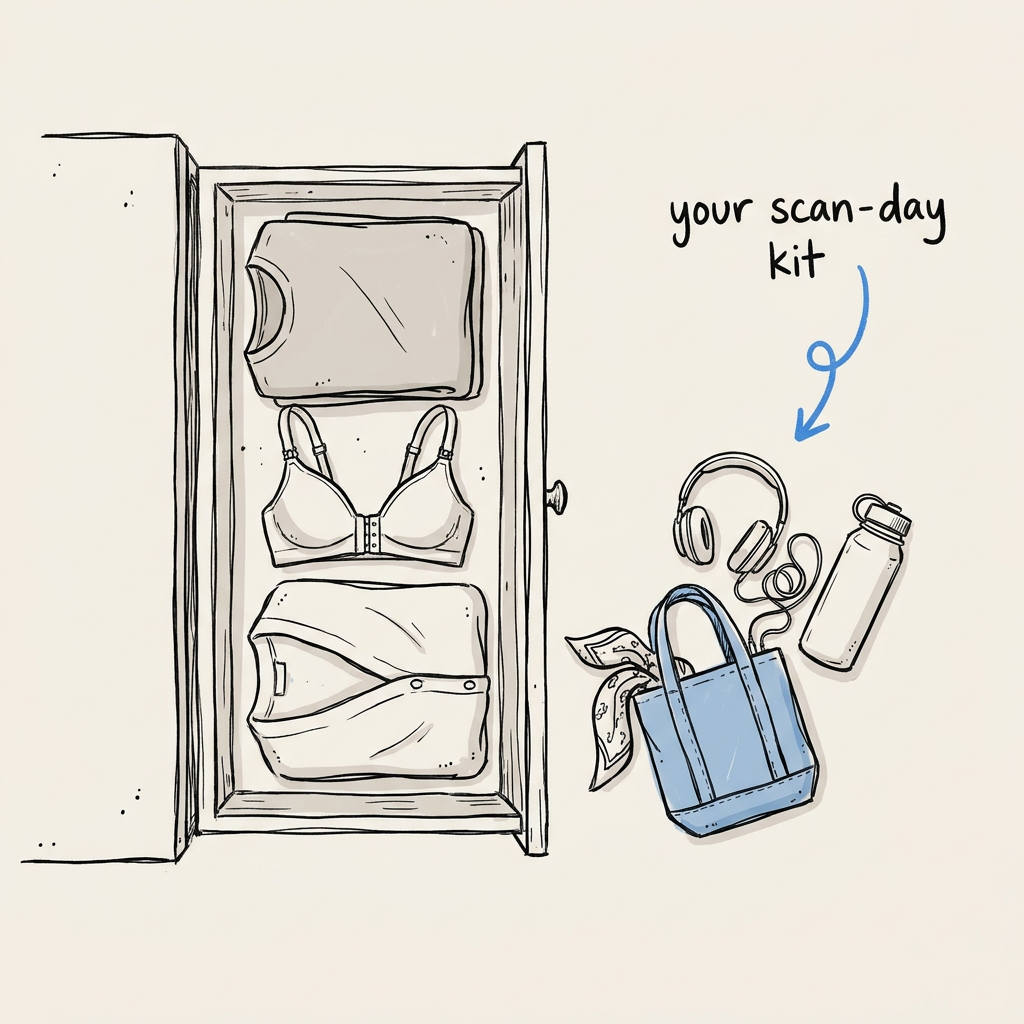
The scan isn’t until 2 p.m., but the day went sideways at 7 a.m.
You opened your dresser and stood there. Not because you didn’t have clothes. Because everything in that drawer carries a question: Will I have to take this off? Will the technician need me to change again? Will this hurt against the skin that still doesn’t feel like mine?
That standing-in-front-of-the-dresser moment is scanxiety. Not the clinical version you read about in pamphlets. The real one. The kind that starts in your body before it reaches your brain.
Over 70% of cancer patients experience it, and it doesn’t fade with time. But most of the advice out there treats scanxiety as a purely mental problem and hands you a list of breathing exercises. That advice isn’t wrong. It’s just incomplete. Because scanxiety lives in your body first, and the most effective way to manage it starts with what you can see, touch, and wear.
What Scanxiety Actually Feels Like
The clinical definition is straightforward: anxiety and distress related to upcoming medical imaging or scan results. Doctors sometimes call it “fear of cancer recurrence,” which is accurate but misses the texture of the experience.
Scanxiety shows up as trouble sleeping the week before the appointment. Poor concentration at work. Snapping at your partner over nothing. A low-grade dread that sits behind your sternum and won’t move. One study found that 32% of patients reported insomnia, 29% described persistent feelings of dread, and 26% couldn’t focus on routine tasks in the days leading up to a follow-up scan.
What the studies don’t capture is the physical memory. Your body was operated on, compressed during imaging, exposed under fluorescent lights. When you walk back into that building for a follow-up, your nervous system doesn’t need a calendar reminder. It remembers.
That’s why the traditional advice to “stay busy” or “practice mindfulness” can feel hollow. Your mind isn’t the only thing that needs managing. Your body needs a plan, too.
Key takeaway: Scanxiety is a physical experience as much as an emotional one, and managing it effectively means addressing both.
Build a Scan-Day Routine You Can Control
When anxiety spikes, control shrinks. Everything feels uncertain: the results, the waiting, the future. A scan-day routine built around tangible, physical choices gives you something concrete to hold onto when everything else feels out of your hands.
Think of it as a pre-game ritual. Athletes have them. Surgeons have them. You get to have one, too.
The night before: Write down your appointment time, the address, and what you need to bring. Set out your clothes. Charge your phone. If journaling your breast cancer journey has been part of your recovery, spend ten minutes putting your thoughts on paper. Not to fix anything. Just to put the noise somewhere outside your head.
The morning of: Stick to your normal morning. Coffee if you drink it. Breakfast if you eat it. The goal is familiar rhythm, not perfection. Avoid checking the patient portal or Googling your scan type. That can wait.
What to bring: A soft blanket or scarf for the waiting room, where it’s always colder than it should be. Headphones and a playlist or podcast that holds your attention. A water bottle. A book or magazine that isn’t about health. A friend or partner, if having someone nearby helps. Some women bring a small comfort object, something that grounds them in the present moment.
Key takeaway: A scan-day routine doesn’t eliminate anxiety, but it replaces uncertainty with familiar, chosen actions that keep you grounded.
What to Wear to a Scan Appointment
This is the part nobody writes about. Every article on scanxiety talks about your mindset. Almost none talk about your closet.
But what you wear to a scan appointment matters. You will likely need to undress from the waist up. You may sit in a gown that opens in the front. You will get dressed again afterward, sometimes quickly, sometimes while your hands are still shaking. What you’re wearing shapes how that entire sequence feels.
Choose a two-piece outfit. A separate top and bottom means you only remove what’s necessary. Skip dresses or jumpsuits that require full undressing.
Wear a front-close bra. A bra that clasps in front is easier to remove and put back on, especially if your range of motion is still limited after surgery. If your bra has a prosthesis pocket, choose one where the form stays secure when you’re repositioning during imaging. A well-fitted mastectomy bra that you know and trust functions as a kind of anchor. Putting it back on after the scan is a small act of returning to yourself. If you’re still wearing a post-surgical compression bra, the same principle applies: front closure, soft fabric, easy on and off.
Choose soft, familiar fabrics. Cotton, bamboo blends, and microfiber sit gently against skin that may still be sensitive from radiation or scarring. Avoid lace or textured fabrics that irritate. Avoid underwires if they press on tender areas.
Skip jewelry and metal. You’ll be asked to remove it anyway. Leave rings, necklaces, and watches at home so you don’t have to worry about keeping track of them in an unfamiliar room.
Layers help. A soft cardigan or zip-up hoodie over your top gives you warmth in the waiting room and an easy on-off option. Layering well with a mastectomy bra is a skill worth developing beyond scan day.
Key takeaway: What you wear to a scan determines how much control you feel during the appointment. A front-close bra, soft fabrics, and a two-piece outfit reduce friction at every step.
Managing the Wait Between Scan and Results
For many women, the scan itself isn’t the hardest part. The waiting is.
The hours or days between imaging and results are when scanxiety peaks. Your body is done with the appointment, but your mind keeps circling. Every phone buzz could be the call. Every notification could be the portal update.
A few strategies that help during the wait:
Set a results timeline with your care team. Before you leave the appointment, ask when you can expect results and how they’ll be delivered. Knowing the window helps. Wondering if you should have heard by now makes everything worse.
Schedule something for after. Not a reward. Not a distraction. Just something that puts you in a different physical space. Lunch with a friend. A walk. An errand that requires your hands and attention. The goal is movement and sensory change, not pretending the wait doesn’t exist.
Limit portal checking. Choose set times to look, rather than refreshing every twenty minutes. Some women hand their phone to a partner and ask them to check once an hour.
Lean on someone who gets it. A friend, a support group, a partner who knows what scan week means. If the emotional weight of survivorship is building up beyond scan days, that’s worth paying attention to. Mental burnout after cancer recovery is real, and recognizing it early matters.
Key takeaway: The waiting period is the most stressful phase of scanxiety. Setting a results timeline and having a post-scan plan reduces the open-ended uncertainty.
When Scanxiety Grows Instead of Fading
Most people assume follow-up anxiety gets easier over time. It often doesn’t. Research shows that scanxiety tends to remain stable or intensify across years of survivorship, especially for breast cancer patients, where up to 70% report ongoing fear of recurrence.
This isn’t a failure of coping. It’s a feature of having survived something serious. Your nervous system learned to protect you, and it doesn’t unlearn that easily.
If scan-day dread is affecting your sleep for more than a few nights, if you’re canceling or delaying appointments to avoid the anxiety, or if the weeks around a scan are disrupting your relationships and daily life, talk to your oncology team about it. Scanxiety is a recognized clinical concern, and there are therapists who specialize in cancer-related distress.
Building daily routines that stick throughout survivorship, not just on scan day, can also help. The rituals that ground you on a Tuesday morning are the same ones that steady you on an imaging day.
Key takeaway: Scanxiety that grows or persists is common and worth discussing with your care team. It doesn’t mean your coping skills are failing. It means your body remembers what it went through.
Your Scan Day Belongs to You
Scanxiety is real, it is physical, and it does not make you weak. It makes you someone who has been through something hard and whose body carries the memory of it.
You can’t control the results. But you can control what you wear, what you bring, and how you prepare. You can choose the bra that feels like yours and not like a medical device. You can build a morning ritual that says, “I’ve done this before, and I know how to do it again.”
The women who walk into our fitting rooms at the Herbert Herman Cancer Center and Karmanos/McLaren Greater Lansing are navigating exactly this. They’re not just shopping for a bra. They’re looking for something that fits their body as it is now and makes one part of a hard day a little easier.
If your bra is adding stress to an already stressful day, that’s something we can fix. Schedule a fitting, or call us to talk through what you need. Our certified fitters have spent nearly 40 years helping women find what works for every chapter, including this one.